
Setting A Standard: Kaz Crotts Didn’t Let A Setback Hinder His Success
PROTECTED CONTENT
If you’re a current subscriber, log in below. If you would like to subscribe, please click the subscribe tab above.
Username and Password Help
Please enter your email and we will send you a password reset link.
by Janice Penix
Heading into his senior year at Lamar, Kaz Crotts had every reason to believe the year could be his best yet, both on the football field and the basketball court.
But an injury in the Warriors’ third game of the football season last September sidelined the standout athlete for months, forcing him to turn his attention toward his recovery and the hope he could join the basketball team before his last year was over.
“I don’t think there are many kids who could go through the type of injury he suffered and then come back during Christmas break and play as well as he did,” Lamar Basketball Coach Kaleb McAnally said. “After his return, we went on a 13-1 run to finish the season, including our final two nonconference games and the rest of our conference schedule, and he earned all-state honors along the way.”
The Injury
During the second quarter of Lamar’s first home game of the season, Crotts broke his fibula and chipped his talus, the bone that connects the lower leg to the foot. He said the experience was surreal.
“When it first happened, I kind of just looked at my leg, and I was like, wow, like, this isn’t real,” he said. “And then my mind kind of just shut off for a while. I wasn’t really sad about it because it felt so fake, it just felt like nothing, like, this isn’t happening right now.”
His adrenaline kept the pain at bay initially, he said.
“It actually didn’t hurt at first, because I had so much adrenaline,” Crotts said. “I knew immediately when I got tackled, I felt the pop and I heard it. Then I was rolled over, and when I’m rolling over, I could kind of feel that my leg was stuck like, in a way it’s not supposed to be. So I’m rolling over and I know it isn’t good.”
After an ambulance ride from Warrior Field to the hospital, Crotts began to turn his attention away from the injury — and the football field — toward a focus on healing. He had surgery a week later, and he said getting healthy in time for basketball was his motivation throughout the rehabilitation process.
“It was a whole roller coaster of emotions,” he said. “I kind of just shut it out, honestly. It was hard to accept that I wasn’t going to get to play football again, so my mind just kind of shut it out and I kind of grew a certain hatred towards football for the remainder of that year.
“I couldn’t stand to think about it. I still supported my team, obviously, but it was hard to even think about football. I just had to focus on like getting back for basketball and shutting (football) out of my life completely. I can think about it now. I’ve accepted it now. I just couldn’t at the time.”
Crotts remained a supportive presence for his football teammates, even when his role changed from player to spectator.
“I would still watch the film, and if there was anything I saw, I would share it with the coaches,” Crotts said. “And I would go to the games, but I would sit in the press box instead of on the sideline. I still wanted to be there for them because they were being there for me, too.
“My injury really showed me how many people cared and supported me. The recovery sucked, but the people supporting me really meant a lot.”
Recovery from his surgery lasted three months, from Sept. 30 until Dec. 30, when he made his senior season debut on the basketball court. By working diligently through therapy and rehab, Crotts managed to miss only two conference games.
“It was a good motivator, and definitely cleared my mind,” he said. “Getting back on the court made me want to go to therapy, to do all the things right. It really kept my enthusiasm alive.”
The Return
McAnally said the senior had an immediate impact on the basketball team when he rejoined the group.
“Kaz is an incredibly tough kid and a great leader,” McAnally said. “When he returned, it was hard to say what we had missed more, the physicality and toughness he brought to our team, or his leadership and ability to hold his teammates accountable on the floor.”
Although Crotts said he felt like he was better at football, he enjoyed basketball more.
“I enjoyed football because I was good at it, but I enjoyed basketball because it’s fun to play,” he said. “Both have their positives, though. I enjoy both of them, don’t get me wrong. But basketball is more fun to play.”
Crotts started playing basketball in elementary school, beginning with youth leagues and continuing through the end of high school. He also played travel ball during the summer.
“I think I was pretty good all the way through,” he said. “I was more of a voice. That’s why I played. I mean, I was always bigger so that would help. But in high school, I think the reason I played my sophomore year was because of my knowledge of the game. So in the year that I normally wouldn’t play that much, I ended up winning the starting spot because of knowing the game more than anything — knowing what to do, knowing the right play, knowing my role, even knowing what was not my shot. I was more of a rebounder and making layups kind of guy in my sophomore year, and I was perfectly fine with that. Whatever I could do for us to win. I was fine without being the star of the show.”
After winning a starting spot his sophomore season, Crotts returned as a starter and standout player his junior season. He earned all-conference honors that year, and was a top prospect with multiple scholarship offers as a senior before his football injury changed his plans.
“I was on limited minutes my senior year, when I came back,” he said. “So for my first two games, I didn’t start. I came off the bench and played like 10 minutes a game, just to get back into the swing of things. But by the third game, which was a conference game, the coach told me I was going to start. So I got a little oxygen bottle, because I still wasn’t in shape for sure, and I needed it during timeouts, just to help me breathe. But I just got stronger the more games I played.”
A versatile player on the court, Crotts primarily played power forward for the Warriors this season.
“I could really play any position,” he said. “There were some games where I brought the ball down. There were some games where I posted up the whole game. So I would play whatever I needed to be.”
His favorite role, however, is point guard.
“I like to pass the ball,” he said. “I don’t like dribbling as much, but I like to come down and make the right read and pass it.”
Crotts said while he is proud to have been a part of the successful Warrior basketball teams for three seasons, he is also grateful for the friendships he has made with his teammates, including the older ones who served as role models for him.
“We’ve gotten super lucky the last couple years with the talent for such a small town,” he said. “And we’re all really, really close to each other. We hang out all the time. Like Ben (Noonan) moved to Walnut Ridge, and we still hang out all the time. And Lane (Miller), he’s still around here, and Caleb (Green) went to Missouri Southern, so he’s a little more distant, but when he comes back down we try to hang out.”
Both Miller and Noonan were mentors for Crotts.
“Lane was a really good model, just because he was always so positive,” Crotts said. “And he would always go into the gym and work on his craft and he’d ask, ‘Hey, you want to come with me?’ So he just set a good example of work ethic for everybody. Ben was a really good role model for work ethic too.”
Younger players who Crotts considers close friends include Kade Boen and Kendrick Carr.
“We’re all really close to each other mentally, like as friends,” Crotts said. “But when we’re on the court together, it’s just different. I understand there are levels of talent, and they’re up there. I’ll pass the ball to them. They can go score, and I get the rebounds. I’m good with that being my role. Anything to win. I’m fine to take the back seat.”
Crotts said he worked to be a role model to the younger Warriors the way his friends had been for him.
“I would say, we didn’t win what we were striving to win this year, but one success I would say I had on this year’s team was preparing them for next year,” he said. “Because when Kendrick gets back from his injury, they’re going to be a really, really good team. And I’m just glad I could help them mentally stay together and focus on the next play. That was a big thing: they’d get too focused on their mistakes, and I’d try to say, ‘Hey, there are a lot of possessions in the game. Look for the next possession, the next play. Shake it off.’”
The Football Player
On the football field, Crotts played running back for the Warriors. He attributes his success in the sport to being exposed to the game from a young age.
“I always wanted to play football,” he said. “I mean, since I was in kindergarten watching the senior high teams play. I’d always go out behind the bleachers at the games and play with other kids, little games where you just get tackled and throw the ball in the air and stuff like that. Whoever picked it up, you’ve got to tackle that guy.
“So my dad saw that I really liked it, and he kind of introduced it to me. I used to watch football with him every Saturday. We would watch the Razorbacks play and go to the games sometimes. So I always liked it.”
His dad began coaching Crotts’ peewee teams in elementary school.
“He went really hard on me,” Crotts said, laughing. “If I didn’t like the sport, that would have made me hate it. But luckily, I liked it, and he just pushed me to be better at it.”
Crotts said he enjoyed the mental aspect of the game more than the physicality.
“I would say I like the mental part, the strategizing, more than the physical part,” he said. “Growing up, when I used to watch the sport, the big hits would get your blood pumping. But I liked to see an offense go on the field and just drive it over and over and over, and be able to break down the defense, and vice versa. I like when a defense can just stop an offense all game.”
Being an observer and student of the game, thanks to his father, gave Crotts an advantage.
“It goes for any sport, basketball too, you can definitely tell when somebody is a fan of the game and when they’re not,” he said. “Also, when they start teaching you fundamentals in peewee, like this is the two hole, this is the four hole, this is the six hole, stuff like that. I was heading that way already, while they were explaining them, because I already knew those terms.”
The Future
In addition to basketball and football, FFA has played a significant role in Crotts’ life, especially as he looks to his future.
Crotts joined FFA in 10th grade, despite his initial misgivings about the value of studying agriculture.
“I’m big in FFA, mainly because of Mr. Chris Bacchus. In ninth grade, he came to talk to us, and it seemed like a cult to me, honestly,” Crotts said, laughing. “I thought, ‘This is weird.’ He would play these videos in class of what it was like, the meetings. They’d stand up and recite the FFA creed, and I’m like, ‘What is going on?’ And you have to wear the same official dress. So I thought, ‘Something weird is going on.’
“And then the more I got into it, the more I understood what it stood for, like how much it mattered to agriculture.”
As a senior, Crotts and three fellow Lamar FFA members were state champions in agronomy. He also earned a state championship in service learning proficiency, earned his State Degree and was awarded a $500 scholarship – accomplishments that seem a far cry from his early reluctance to join the organization.
“After my 10th grade year, I got invited to the national convention in Indianapolis, and that is what really pushed me over the edge to say, I want to actually do stuff in FFA,” he said.
That year, Crotts was awarded a $1,000 grant to start a poultry project.
“I built a coop with my dad, and we bought like 10 chickens,” Crotts said. “Now it’s turned into seven coops and 100 chickens, and we sell eggs now.”
A self-described “city kid,” who didn’t grow up on a farm or in an agricultural environment, Crotts said it wasn’t sports but FFA that helped him determine the career he wants to pursue. This fall, he will attend the University of Arkansas in Fayetteville where he will work to obtain a degree in poultry science.
“FFA brought a whole new perspective, and actually what I’m doing for a career is because of it,” he said. “If you told me four years ago that I would be going to college for poultry science, I’d say you’re lying. But Chris really introduced me to certain things and the opportunities that are out there.”
Crotts has also been able to use his knowledge of poultry science to help with a ministry project, traveling to Central America with a group led by Bobby Noonan, father of Crotts’ friend and former teammate, Ben.
“I went to Guatemala with Bobby on a mission trip,” Crotts said. “Me, Chris (Bacchus) and Ben (Noonan) went one year and built chicken coops for the community. It was pretty cool. After that, we started building houses there.”
He said he plans to return this year to assist with another home-building project.
After getting his poultry science degree, Crotts said he hopes to attend law school to combine his agricultural interests with his desire to work in the legal system.
“This sounds weird, but my plan is for four years, I’m going to do poultry science and then get a job right after I graduate, for like a buffer period,” he said. “But I plan to actually become a lawyer. I’m sure I’ll have to go back to school and get a different major to get into law school, because I don’t know any law school that’s going to accept a poultry science major. But I will work while I’m getting a different degree, and my end goal, if everything goes planned, is to be a lawyer for a corporation like Tyson, a corporation that sells chickens. So I’m actually putting the poultry science into use.
“It’s really weird, because if anybody ever asks me what I’m doing, I say, ‘I’m going to be a chicken lawyer.’ That’s a very specific answer that they usually don’t see coming.”
Crotts comes from a large family. The son of Tanif and Christina Crotts, he has twin brothers and three sisters.
His brothers have coached him in travel basketball, an experience Crotts said he has enjoyed.
“It’s fun,” he said. “They just kind of let us do what we wanted, but we are definitely close so I’ve liked getting to do that with them.”
Crotts has two older sisters, Sadi, who teaches at Lamar, and Haley, a nurse practitioner who operates the school-based health clinic at Lamar. His younger sister, Myla, is seven.
As Crotts’ time at Lamar came to a close, his coach acknowledged the senior’s strength in coming back from a significant injury to achieve All-State status and to be a role model for future Warriors.
“Kaz was injured again at the end of our final regular-season game on Senior Night, but he gutted it out and played through the injury for the rest of the postseason,” McAnally said. “He’s the kind of player every coach hopes to have: a tough kid, a great leader, and someone who sets the standard for his teammates.”
Read this story and others in the June 3 issue of The Graphic, available online and at businesses throughout Franklin and Johnson counties. Subscribe or donate here to support more hometown journalism.

Kaz Crotts (Photo courtesy Kaylee Young)

Kaz Crotts (Photo courtesy Kaylee Young)
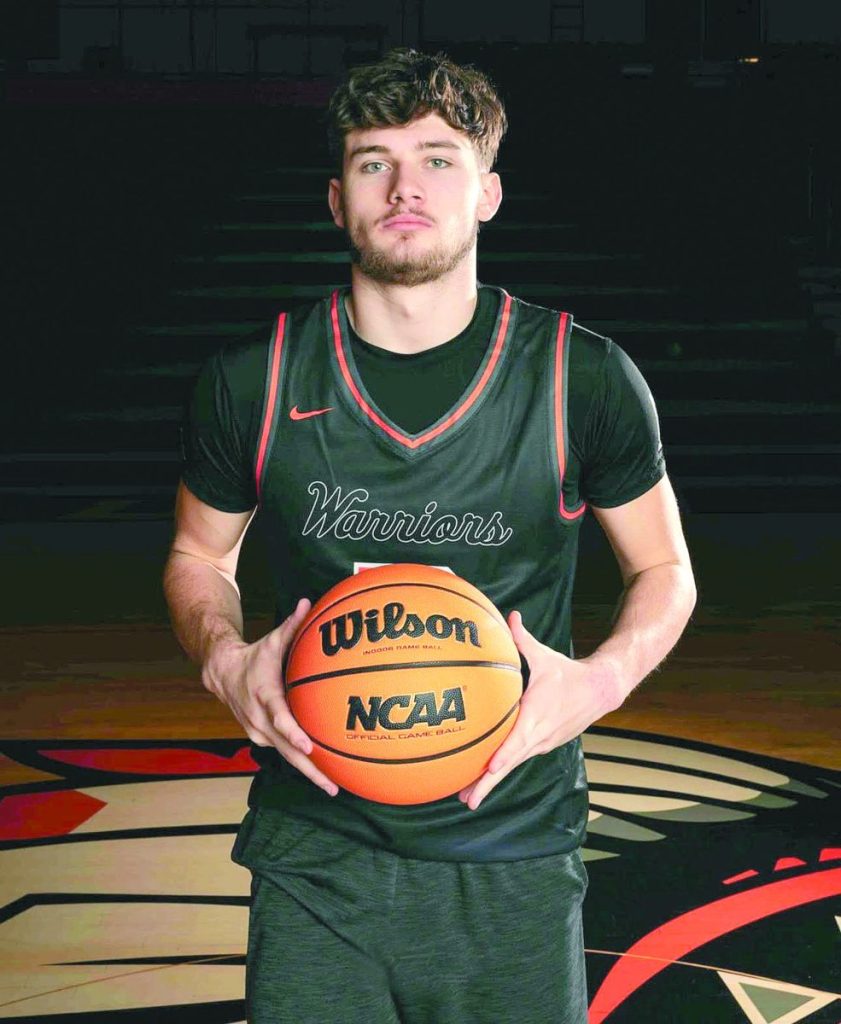
Kaz Crotts (Photo courtesy Konnor’s Captures)
Related Posts