
Residents Seek Answers At Data Center Forum As Questions Remain
LOCAL GOVERNMENT COVERAGE – DATA CENTER
by Megan Wylie
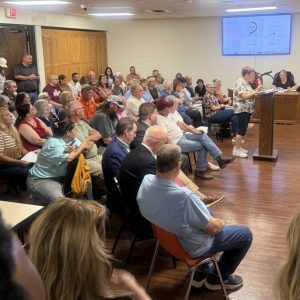
What was planned as a moderated forum to address community questions about the hyperscale data center instead became an extended exchange between residents and Aldermen Christel Thompson and Eddie King, the only two city officials in attendance, with many questions involving contracts, agreements and technical details left unanswered.
Thompson first addressed the audience stating, “I’m grateful for all of you here tonight because this is democracy. I don’t think there’s anything wrong with questions. I appreciate your time.”
As residents pressed for answers about the project’s agreements, utility demands and long-term commitments, Thompson acknowledged the city had not done enough to inform residents about the project.
“We as a city did not do a good job of informing you of what is coming,” Thompson said. “A suggestion to the council is to get out ahead of that.”
More than 75 people attended the July 13 forum at the University of the Ozarks’ Walton Fine Arts Center, where more than 80 questions had been submitted in advance by residents. Organized by community members and moderated by Gail Choate, executive director of the Arkansas Civic Action Network, the event was originally intended to address those questions by topic.
Instead, audience members quickly began asking questions directly from the floor, with much of the discussion focused on transparency, documentation, utility impacts, financial commitments and accountability.
Forum Participants
Organizers invited several local and state officials, as well as representatives connected to the data center project, to participate in the forum.
Those invited included:
— State Rep. Aaron Pilkington, who informed organizers he would be out of the country;
— Mayor David Rieder;
— Clarksville City Council members King, Thompson, Patrick Baker, Ed Bradley, Rob Risinger and Robert Thompson;
— Johnson County Assessor Rusty Hardgrave;
— Clarksville City Engineer Morgan Barrett;
— Clarksville City Inspector Cody Graham;
— Clarksville Connected Utilities Interim General Manager Eric Heinrichs; and
— A representative from Serverfarm.
Thompson and King were the only officials who attended the forum. No representative from Serverfarm attended.
Rieder was also not present. Three days before the forum, he announced he would hold a State of the City presentation immediately following Monday’s City Council meeting, which took place at the same time as the forum.
Several audience members questioned why the mayor and other officials with direct knowledge of the project were not in attendance to answer residents’ questions and expressed disappointment invited officials were not present.
Choate told attendees she had invited city officials, including the mayor, as well as a representative from Serverfarm.
“The people who have the answers to these questions aren’t here,” Choate said, while encouraging attendees not to direct their frustration toward Thompson and King, who said they were responding with the information available to them.
The forum followed months of public discussion surrounding the proposed data center project, including questions about transparency, water and power usage, environmental impacts, tax incentives and long-term community benefits.
Ahead of the meeting, Serverfarm placed an advertisement in The Graphic directing readers to its Arkansas project webpage (serverfarmllc.com/arkansas), which describes the proposed campus, projected economic benefits and other details about the development.
From Skepticism To Support
Both Thompson and King said they were initially skeptical of the project but changed their views after visiting operating data centers and speaking with company representatives.
King said he toured a data center in Olive Branch, Miss., where he focused on concerns including noise, water use and employment.
He said the facility was quieter than he expected and representatives answered questions he had before the visit.
Thompson said she visited Google’s data center in Pryor, Okla., expecting to find many of the concerns residents have raised about the Clarksville project.
Instead, she said she was encouraged by the facility’s partnership with local schools, workforce training opportunities and the potential for additional property tax revenue to support education.
She said the school system was her primary concern before making the trip.
King also cited the potential economic impact of the project and said company representatives had indicated they planned to invest in infrastructure associated with the development.
Residents Sought Documentation
While Thompson and King described what they learned during their visits, several audience members questioned whether those commitments were contained in legally enforceable agreements or were based on verbal assurances from company representatives.
Residents asked where agreements could be reviewed, who would enforce commitments made by the company and what protections would exist if promised benefits did not materialize.
Those questions often led to Thompson and King acknowledging they did not have the information needed to provide specific answers and often the Council members did not receive information until the meetings.
For example, Thompson stated she found out about the industrial development bond issuances on Facebook. (More information on the bond issuances may be found on Page 1 of both the July 1 and July 8 issues of The Graphic .)
“I cannot answer all these questions,” Thompson said. “They’re good questions.”
She added she had hoped additional officials with more detailed knowledge of the project would attend.
“I had hoped the mayor and others who could answer them would be here,” she said.
King also acknowledged limitations on what he could answer.
When discussion turned to the proposed community benefits agreement and Electric Service Agreement (ESA), Thompson said the ESA had been tabled and the community benefits agreement had been removed from Monday night’s City Council agenda and members had not yet received copies. (More information about the ESA may be found on Page 1 of both the June 24 and July 8 issues of The Graphic.)
When an audience member asked why the city was allowing the project to move forward without community benefit agreements already in place, King replied, “We can’t make them do anything, but we can ask them.”
Questions About Accountability And Impact
Although the discussion covered a wide range of topics, several themes emerged throughout the evening.
Residents questioned the use of nondisclosure agreements during the project’s early stages, future phases of development, water use, electric infrastructure, environmental monitoring, tax incentives and construction impacts.
Residents also questioned how state and local tax incentives would affect projected public benefits from the project. The Arkansas Legislature has approved incentives for qualified data centers, including legislation sponsored by Rep. Aaron Pilkington that expanded sales and use tax exemptions for data centers. Residents also asked about the project’s proposed property tax treatment and how incentives would affect projected revenue for local governments and schools.
Several attendees also questioned whether utility upgrades, infrastructure improvements and other publicly discussed commitments had been incorporated into binding agreements.
King said environmental monitoring would primarily fall under state agencies and noted utility-related agreements were still being negotiated.
He also said CCU has repeatedly stated Serverfarm will be responsible for any upgrades or other expenses related to the project, adding they have already property near Ludwig to build substations and is in the process of purchasing private property “almost to Lamar” from the current construction site.
When asked about construction impacts near Johnson Regional Medical Center, King said he planned to contact Serverfarm representatives regarding concerns about dust affecting the hospital’s air filters after receiving contact information during the meeting.
Continued Public Involvement
Choate encouraged residents to continue asking questions of elected officials and to remain involved in local government.
She reminded attendees Arkansas’ Freedom of Information Act provides a process for requesting public records and encouraged residents to attend meetings, serve on boards and communicate regularly with elected officials.
When asked by Choate if it would be possible to have town hall-style meetings hosted by Serverfarm, Thompson said, “I don’t see why not, and if they aren’t willing we need to take on the responsibility to do that.”
The meeting concluded shortly after 9 p.m. with appreciation being expressed for Thompson and King’s willingness to attend and attempt to answer questions.
After the forum, organizer Heather Fresard told attendees she had personally invited Rieder to participate and had provided his office with the compiled list of community questions. According to Fresard, the mayor declined the invitation, saying he was “not going to play politics.”
Following the meeting, Fresard told The Graphic she appreciated Thompson and King attending the forum and expressed disappointment other invited officials did not participate.
See related coverage on Page X for a report on Monday’s City Council meeting and Rieder’s State of the City presentation.
—–
Published In This Week’s Edition
This story appears in the July 15, 2026, edition of The Graphic, available online and at businesses throughout Johnson and Franklin counties.
Support Local Accountability Reporting
Our reporting is made possible by readers, not algorithms.
The Graphic covers the decisions that affect your taxes, schools, utilities, and local government across Johnson and Franklin counties.
We attend and report on:
City councils
School boards
Quorum courts
Clarksville Connected Utilities
Johnson Regional Medical Center board
Your subscription makes this coverage possible.
Become a Subscriber or Donate Today