
JC Quorum Court Waits On Ordinance Regulating Mineral Extractions; Committee Formed To Delve Into Issue After Legal Questions Raised
PROTECTED CONTENT
If you’re a current subscriber, log in below. If you would like to subscribe, please click the subscribe tab above.
Username and Password Help
Please enter your email and we will send you a password reset link.
by Janice Penix
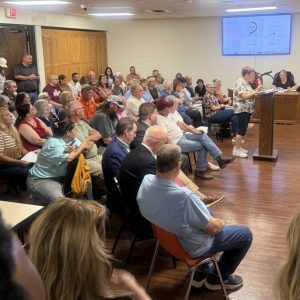
The Johnson County Quorum Court tabled an ordinance at its monthly meeting Thursday which would regulate mineral extraction near high-investment developments such as the Serverfarm data center being constructed in Clarksville.
Justices of the peace voted to form a committee to look further into the issue after questions about the legality of the proposal were raised by representatives from oil and gas associations.
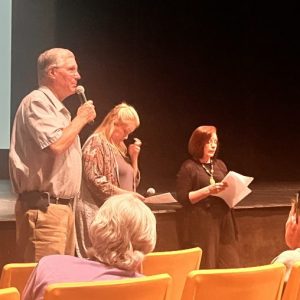
“We see this as a property rights issue,” Rodney Baker, director of government relations for the Arkansas Independent Producers and Royalty Owners (AIPRO), said. “The legality is questionable.”
The ordinance, which Johnson County Judge Herman Houston told the Court was brought to him by State Representative Aaron Pilkington, would prohibit surface disruption associated with mineral extraction activities on or adjacent to any building or structure classified as a “critical facility.”
Critical facilities, as defined by the ordinance, would include buildings used for 24-hour medical care; buildings used for moderate-hazard storage, including combustible materials; buildings used for low-hazard storage; and any development containing one or more of the following uses with a minimum investment of $100 million:
–Data centers and colocation facilities;
–Hotels, motels, and lodging establishments;
–Restaurants and food service establishments;
–Gas stations and fueling facilities;
–Distribution centers, warehousing and logistics facilities;
–Grocery stores and supermarkets;
–Large-format retail establishments and similar high-traffic commercial developments.
The ordinance would prohibit horizontal drilling or directional drilling operations within 500 feet of the property boundary of any parcel containing a critical facility. It also states mineral owners or mineral lessees would retain the right to access and recover their minerals through operations conducted at depths greater than 1,000 feet below the surface, provided such operations do not involve surface disruption on the protected parcels or within setback distances established in the ordinance.
Alan Perkins, an oil and gas attorney from PPGMR in Little Rock who represents the Arkansas Oil and Gas Commission (AOGC), said he saw two basic problems with the ordinance. First, Perkins said, the ordinance would prevent property owners from accessing their minerals. “When a party owns mineral rights, they have the right to use the surface to produce those minerals,” Perkins said. “It’s really difficult to pass a law, an ordinance, to say, ‘You can’t do that.” That would make it subject to a challenge, and I don’t believe you’d survive that challenge.”
The second issue Perkins raised is the county’s authority to regulate mineral rights issues, which he said is given to the AOGC by state law.
“State statute gives the Arkansas Oil and Gas Commission the exclusive authority to regulate,” he said. “Really, the county doesn’t have that authority. There are ways to work these things out. There are ways to solve the problem besides an ordinance that excludes it.”
Baker said he understood the proposal was related to the high-investment data center being developed, and assured the Court he was not anti-development. He urged members to delay action on the ordinance to allow for additional input and collaboration among representatives from the oil and gas organizations as well as the data center developer.
Jason Carter, attorney for Clarksville Connected Utilities who has been working with the utility to negotiate with the data center developer, also addressed the Court.
Carter said while a large part of the development is located inside the city limits, portions will expand into the county.
“The reason this is being presented now is we are negotiating a substantial development, some of which spills outside the city into the county,” Carter said. “It will represent billions of dollars of investment in this community. We are doing whatever we can to give the developers confidence moving forward.”
Carter said because data center development is relatively new in Arkansas, he has looked to other states to determine the best proposals.
“We looked to other states, at their regulatory structures, as to how it might work in Arkansas,” he said. “We want to preserve the ability for people to access their rights, but I think what we are trying to do here is to establish a framework, a distance from the parcel.
“I think (if you were challenged in court), you’d find that in Arkansas, we don’t have an extensive body of law. That’s why we looked to other states. This kind of deep and horizontal drilling is new, but it does allow people to extract their minerals.”
Pilkington said he worked with the Association of Arkansas Counties, asking organization’s assistance to draft a proposed ordinance.
“I think we drafted it in a way that gives you flexibility,” he said. “I can understand why people are concerned, and we want to make things work well. We are not trying to cause problems. We’re happy to make changes to make it work.”
Justice of the Peace Ray Hobbs said he didn’t want the Court to rush into a decision.
“Based on the comments earlier, Why wouldn’t we take a little more time, to make sure that we’re not gonna create legal activity here, and make this positive. If you want to make it positive, let’s work through it,” Hobbs said. “There are already some negatives about the data center that people don’t understand, so let’s don’t make it any worse. I think we’ve got to take some time and work through it.”
Justice of the Peace Kris Muldoon suggested a committee be formed to work with the parties involved on the ordinance proposal. Initially, Houston appointed three Court members, Van Hill, Katie Howard and Muldoon, but after others requested to participate, it was revised to a committee of the whole.
Houston said he will work to set the first meeting quickly.
Other Matters
–The Court heard updates on the radio tower and district court projects. Both are reported to be progressing on schedule. Emery Thieme of KA-Comm, the contractor overseeing the tower project, reported changes to the system design and configuration had to be made due to a relocation of the server, but engineers are scheduled to confirm the new configurations next week.
–Sheriff Grant Nicely reported the sheriff’s office has reactivated its Facebook page.
–James Ritchie, Johnson County library branch manager, invited the Court and community to a ribbon cutting ceremony for the library’s expansion. The event will be held at 11:30 a.m. Thursday, April 16.
Read this story and others in the April 15 issue of The Graphic, available online and at businesses throughout Franklin and Johnson counties. Subscribe or donate here to support more hometown journalism.
Related Posts