
Finding Their Heaven On Earth; Parkers Are The 2026 Johnson County Farm Family Of The Year
COMMUNITY FEATURE COVERAGE
by Janice Penix
Shane and Amber Parker had always planned to move to a quiet, country farm when they became empty-nesters.
Living in a spacious home on Piney Bay in eastern Johnson County, the two had ample room to raise their daughter – and Shane’s three older daughters – with plenty of recreational opportunities right out their back door, and great neighbors as a bonus.
But when their teenage daughter, Mylee, spent a weekend at a much smaller farmhouse the couple bought on the west side of the county three years ago, she didn’t want to leave.
“We were expecting to move to the farm once Mylee went to college, not two-and-a-half or three years before that,” Shane said. “She grew up at Knoxville, at a house that we had for 18 or 19 years on the lake. Me and Amber knew we didn’t need a 5,000-square-foot house. It was just going to be me and her, once Mylee moves to college. The older three girls have been gone for 10 years.
“The farmhouse is 3,400 square feet. It’s perfect. It’s just a plain Jane, simple ranch-style house. So I told them two-and-a-half years ago, ‘We need to stay out there on the weekends, because that way Mylee gets to enjoy some farm life. Then we’ll stay at Knoxville during the week, because it’s closer to Lamar for her to go to school.’
“We went out on a Friday, and then that Sunday, I said, ‘Y’all ready to go back?’ And they said, ‘No.’ So we’ve been out there ever since. I think we’ve stayed in the Knoxville house two nights, maybe.”
A Growing, Changing Herd
Their farm, Shamber Farms, is a cow-calf operation that encompasses approximately 900 acres on three locations in Johnson County, including 150 acres adjacent to Shane’s veterinary practice, Parker Animal Clinic; around 400 acres off Hudson Springs Road, north of the veterinary clinic; and 275 acres in the Bethlehem Community, where the family farmhouse is located.
The cattle operation, which currently consists of about 360 momma cows, has grown in recent years, thanks to Mylee’s interest in show animals. She has approximately 40 registered exotic breed bulls and heifers that she shows in competitions.
“I started off showing bulls, and I started off with the Sim-Solution,” Mylee said. “It’s not a purebred Cemental, it’s a percentage of Cemental, but it’s an exotic breed. Then I showed a Maine-Anjou bull and a Chianina heifer.”
Mylee began showing two years ago, when she was a junior in high school. She has shown at the Arkansas Youth Expo, the largest event in the state, as well as in Denver, Colo., and Oklahoma City, but she took up the hobby somewhat reluctantly.
“We bought a bull, and he was going to be a herd bull,” Mylee said. “But he had been a show bull, and he still had a little bit of time left that he could show. My mom said, ‘You need to try it out. You need to do it, just to see if you like it.’ But I thought, ‘I’m 16 years old. Most kids start when they’re like eight or 10.’ So I was not going to do it.”
Shane said Amber was determined to get a show bull on the farm.
“Amber overheard me and Kyle, our farm manager, talking,” Shane said. “I said, ‘Find me another herd bull.’ So he found one, but he told me we couldn’t get him until October, because he was still being shown. Amber heard, ‘show bull,’ and the farm we bought actually has a cool room, where you put show animals during the heat. Except it was just a room, it didn’t have air conditioning. So after another $6,800 for the AC unit, we actually made it into a cool room. That’s how it actually got started. We bought a $5,000 herd bull, which is cheap in the show world, and we started from there.”
Soon after that, Mylee, who is only five-and-a-half-feet tall and doesn’t weigh much more than 100 pounds, was persuaded to start showing cows that weigh 2,200-2,400 pounds, more than a ton.
“I didn’t even want to do it at first,” she said. “I was too skeptical, because I’m mainly into sports. I’m not super into showing or anything. But I have a friend who shows and she said, ‘You need to try it.’ So both my mom and then my friend talked me into it, and I ended up loving it.”
Once Mylee began showing, her parents were all-in, purchasing the trailer and equipment needed. She and her mom also become attached to the animals, they said.
“Needless to say, once she shows and they age out, they do not leave, because we’re so attached,” Amber said.
When a bull is two years old, it is retired from showing, Shane explained.
“That’s when he’s reaching puberty, and he realizes he’s a boy,” he said. “They start trying to rough her up in the ring, push her around, because they realize they’re big.”
Although the Parkers began by purchasing show bulls and heifers, they now breed their own.
“We’re getting to the point where we’re raising our own show-quality animals,” Amber said. “Before, we always had commercial cows, but once Mylee got into the show world, we started trying to improve our herd on the registered/show side of things, which is a very small herd compared to the rest of what we have on the commercial side. We now use those bulls that she showed, and the heifer she showed, in that herd, trying to reproduce more show-quality cattle.”
Improving the stock can benefit the resale value of the Parkers’ animals and also provides cows for other youth who are interested in showing, Amber and Shane explained.
“Kyle, who works for us, his son is seven, and he shows,” Shane said. “So we’re going to keep him with an animal to show the whole time. Since we bought all this stuff, somebody’s going to have to use it.”
Building Shamber Farms
Shane was raised on a poultry farm in Johnson County but said he was not interested in taking over the operation when he was grown.
“I lived on a turkey farm when I was in high school, and that’s really what made me want to go to vet school,” he said. “I didn’t want to farm, or didn’t want to poultry farm anyway. Because turkeys you’re never out of.”
However, he began acquiring land after he opened his veterinary practice in the early 2000s.
“When we first built the clinic here, we bought about 45 or 50 acres on the same side of the road, but we didn’t run cattle for years,” Shane said. “Me and my dad messed around with cattle a little bit after I opened the clinic, but nothing big.”
Amber was raised in Gravelly, a small community in Yell County. Her parents both worked full-time jobs, her mom at a school and her dad at a chemical plant. But her family owned a small number of cattle and horses.
“We had some land, and had a small little cow herd,” she said. “I loved horses, so I had horses. But of course, we were a working family, so we had to find the cheapest horses out there. Usually they were the ones that didn’t mind very well. But I was able to do play days and stuff like that on my horses. I would always be involved, helping with the cattle and the hay, or the brush hogging, when my dad would let me help with that.”
Her grandfather also helped Amber’s father on the small farm, but as he got older, the family eventually moved to Danville, and her dad began selling the family’s cattle.
“He kept them around for my grandpa, but he just couldn’t handle them and take care of them,” Amber said. “And he didn’t want him to get hurt, so we ended up getting rid of those and moving to Danville. But we still have that property over there, that will go to my brother and I. That land has been in the family for three or four generations, and it’s something I would probably never, ever get rid of either.”
In 2017, Shane began purchasing cows.
“We only had this 50 acres, and then I bought another 105, so it’s been kind of a little at a time,” Shane said. “So we had 40 or 50 cows on 150 acres. The big purchases (at Bethlehem), the big land property, we weren’t even really looking, to be honest. I’ve got a client that had both of those properties, and I texted him one day to see if he would lease me 100 acres where I could run some more cows.
“The next thing I know, he said, ‘Why don’t you come buy half of the 407?’ So me and Amber went out there, and then when we got there, he showed me the plat and it was 407 acres. I said, ‘This is the whole thing. This isn’t half.’”
Amber said she knew they wanted the land when they saw it, so the couple purchased the 407 acres. About a year later, they bought the house the previous owner had built on the land, and another 275 acres.
“It has been a true blessing in disguise,” Amber said. “Because we’ve lived at Knoxville, in a neighborhood, and with wonderful neighbors. We love that area. But whenever this came available, we knew Shane and I wanted to do this after Mylee graduated. Once we got out there, and we had the show animals, Mylee didn’t realize how much she enjoyed that side of things. She had never had that, because we lived in a neighborhood. It was really a blessing in disguise, how everything has worked out the way it has, even though in our minds, the timing wasn’t exactly what we expected.”
Mylee knew the timing was perfect for her, the first weekend she stayed in the farmhouse.
“I mean, it was just something completely different than what I was used to,” she said. “I was used to going out on the lake, going tubing, just not really having much to do with the cattle, except every once in a while, when Dad would have me come tag along to work cows. But once I was there, I got attached to the cattle, honestly.
“And then just looking out on the back porch, our view there is just so beautiful with the mountains and everything, and I thought, ‘Wow, this is really pretty. I don’t really want to go back.’”
Making Farm Life Work
Although Shane did not want to own poultry houses, cattle was another story.
“The cattle helped put the older girls through college, paid for tuition,” he said. “But since I was a teenager, I have always been involved with cattle.”
With his full-time veterinary practice keeping both he and Amber busy, Shane said he relies on Kyle Green, his farm manager, to ensure things run smoothly for Shamber Farms.
“That’s the key,” he said. “I’ve got probably four full-time guys that help with the farm stuff, but Kyle pretty well takes care of the cattle during the week, and then on the weekend, I take care of them. But every other weekend I’m working here until noon or 2:00. So it’s a rush to get through everything on Saturday, especially when the time changes.”
Amber agreed.
“It’s nice having Kyle, because if we have a calving situation, or if there’s a cow that needs doctored, he can handle that,” she said. “He tags all the cattle, works our cattle for us. He’s a jack of all trades when it comes to that. He doesn’t have to say, ‘Hey, I need you out to pull this calf.’ He takes the reins and handles all that. So that is a big relief on us.”
Shane said he has worked to make the farm’s operations efficient, to help make tasks somewhat easier to manage.
“We’re pretty much set up to where one person can pretty well do anything,” he said. “Like, we’ve got a feed truck, and it’s got a big feeder on the back. Those cattle would follow you from here to Lamar, because they know what that is. So it’s easy to get them up in them. All of our farms are set up where one person can move them. They all have alleyways and connect to every pasture. So it’s pretty efficient.”
Besides working cattle, there is also a hay crop to manage. Shane’s father, Loyd Parker, pitches in to help his son with that task.
“I take Wednesdays off from the clinic, and on my last day off, I spent 12 hours in the hay field, on my day off, just trying to get half of it up,” Shane said. “My dad does most of the hay for me, but he’s 80 years old. Yesterday was the first time I’ve ever seen him say, ‘I’m too tired, I’m going to the house.’ But he had baled hay all morning, and I took over and finished it. So he helps quite a bit with the hay.”
Hay season is one of the most hectic seasons of the year for the family.
“This is the busiest time, because we’re trying to put hay up, we’re trying to spread litter,” Shane said. “I’ve got two guys full time that have been spreading litter for almost two weeks now, and I helped them two days.”
Amber agreed.
“There’s brush hogging, there’s all the mowing, everything like that to be done,” she said. “There’s always something to do.”
At the same time, the clinic enters one of its busiest season with large animals.
“Then here at the clinic, it’s breeding season for horses, so I have to deal with that,” Shane said. “Time has always been the biggest challenge for me, just managing time and everybody at once. Because even on my days off when I’m on the farm, I’m still watching the clinic on camera, just to make sure everything’s flowing.”
A Future Waiting At Home
Shane and Amber hope to continue to expand their operation, and Shane said he keeps his eye out for land that may come on the market near their current farm sites.
“We just want to keep growing, land-wise and cattle-wise, and to keep that going as long as we can because it’s something that we really enjoy,” Amber said. “We hope to hand that down, if Mylee’s interested after she goes off to college. As of now, she’s looking at coming back to the area. She wants to purchase her own land, and then start her own cattle. You can tell she has grown a true love for it, and she didn’t realize she would love it so much.”
Mylee will begin college at the University of Arkansas this fall, but she said her heart will still be on the farm. For her parents, the future of Shamber Farms looks promising, especially knowing she will be eager to return.
“Mylee had orientation for college a couple of weeks ago,” Amber said. “It was two days full of stuff, and I looked over at her at one point and asked, ‘What do you think?’ And she said, ‘Well, I was a little scared and nervous, but now, I really am. My head’s spinning with all the information they’re throwing at us.’
“But whenever we drove back after that second day, she said, ‘I am so ready to just be back on the farm. It is a huge stress reliever.’ So that’s something that I am looking forward to whenever she does go off to college. It sounds like she will be back to see us on the weekends. She will miss it.”
The couple agrees they have been blessed to see their farm provide a home and a future for their family.
“It has been a true blessing,” Shane said. “Things could have easily turned out differently, because the guy we bought it from could have sold it to someone from out of town, with unbelievable pricing. But the timing really was a blessing in disguise. At first, I was like, ‘Oh gosh, we’re not ready.’ But then I’m so glad it just happened the way it did.”
Amber agreed.
“It is so peaceful out there,” she said. “It’s just a little piece of heaven on earth.”
—–
Published In This Week’s Edition
This story appears in the June 17, 2026, edition of The Graphic, available online and at businesses throughout Johnson and Franklin counties.
Support Community Journalism
The Graphic shares the stories of the people, places and traditions that make Johnson and Franklin counties unique. From local businesses and community events to student achievements and hometown history, your subscription helps us continue telling the stories that connect our communities.
Become a Subscriber or Donate Today
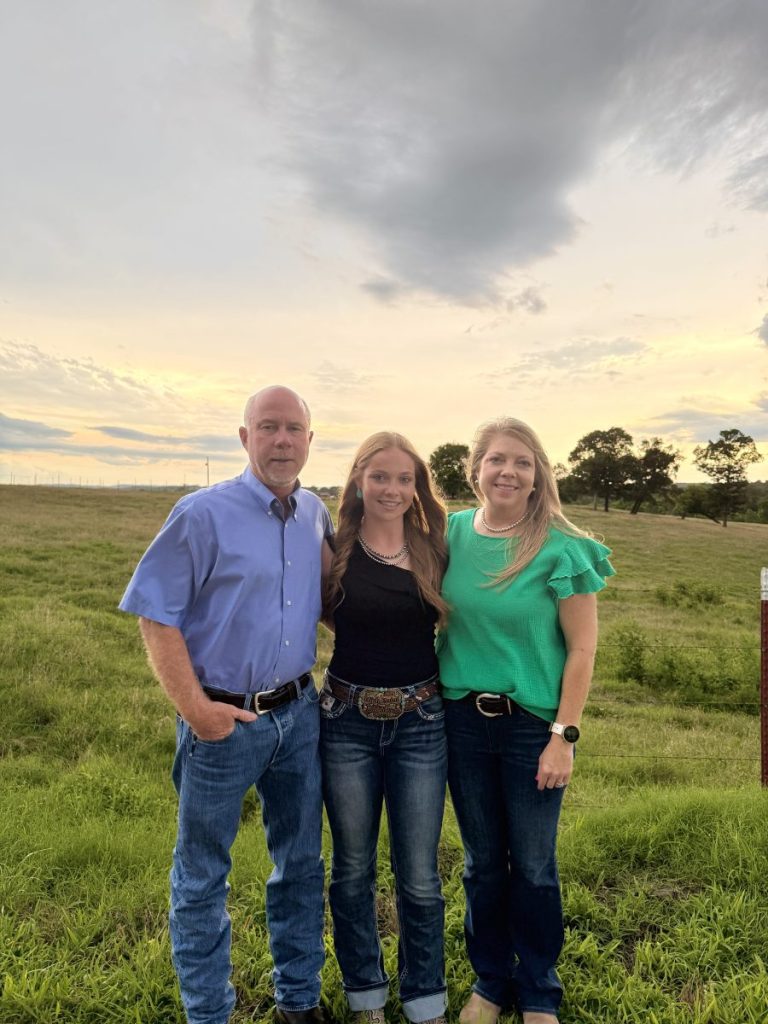
Shane, Mylee and Amber Parker