
School Is ‘Ruff’; Therapy Dog Marshall Makes ‘Pawsitive’ Impact At Lamar Elementary
PROTECTED CONTENT
If you’re a current subscriber, log in below. If you would like to subscribe, please click the subscribe tab above.
Username and Password Help
Please enter your email and we will send you a password reset link.
by Stephanie Baker
Students and staff at Lamar Elementary are seeing a new friendly face in the hallways: Marshall, a therapy dog who is already making an impact in the school community.
A two-year-old German wirehaired pointer and American Foxhound mix, Marshall, recently began working alongside third-grade teacher Diana Bratton as a therapy dog. He has been trained to provide emotional support, reduce stress, and help create a positive environment for students. As a therapy dog, he has been trained to help people who are having a “ruff” day. After only a few days on campus, Marshall has been doing just that.
“We are excited to welcome Marshall as our new therapy dog and begin the process of getting to know him and helping him get acquainted with our students and staff,” said Lamar Elementary Principal Jessica Hughes. “Even in these early days, there has been a lot of enthusiasm and curiosity throughout the building about his arrival. We are confident that Marshall will support students with social and emotional regulation while also providing a calm and comforting presence in our school. Experiences like this help students build empathy, confidence, and positive connections with others. As we continue getting to know Marshall, we are certain he will become a valued and loved member of our school community.”
Bratton is a veteran teacher, who has spent 27 years in education, with the last four of those at Lamar. She began thinking about the possibility of a therapy dog about two years ago. The idea first caught her attention after seeing therapy dogs used in classrooms on social media, and the concept immediately resonated with her approach to teaching. She said she became passionate about the idea after researching how a therapy dog could help support her students and fellow staff.
“Marshall helps me be a better teacher,” said Bratton, explaining he helps care for students that she may not even realize are in need of the extra support.
Marshall’s training includes a unique skill that allows him to respond to people who are experiencing stress. He is trained to smell a person’s breath and detect cortisol levels, the hormone associated with stress. When he senses elevated levels, Marshall encourages interaction by resting his head in a person’s lap and inviting them to pet him.
The physical interaction helps the person self-regulate. Once cortisol levels return to normal, Marshall moves on to help another person. When Marshall is not needed for support, he stays in his spot under Bratton’s desk, waiting until he is needed again.
While service dogs are trained to assist a specific individual, therapy dogs are trained to interact with and support many different people in settings such as schools, hospitals and community programs.
Bratton said she believes deeply in creating a classroom environment where students feel loved and supported. Her passion for teaching traces back to her own childhood experience with a third-grade teacher who made a lasting impression, who helped support her during a transition after moving when she experienced difficulties learning multiplication and cursive, which she had not yet learned at her previous school. Mrs. Olmos helped her feel supported, which helped her learn, and inspired a passion for teaching, Bratton said.
Just like her own third-grade teacher, Bratton now strives to make sure her students know how much they are valued. Each day, her students are greeted with a smile, a hug, and a reminder that they are loved.
The addition of Marshall is another way to provide that support, especially during what Bratton described as a challenging time in education.
The field of teaching has become “unbelievably difficult,” she said, explaining more students are dealing with difficult home situations and teachers are receiving less parental support than in the past. In some cases, Bratton said, a teacher may serve as the “only stable adult” a student has in their life. Despite the challenges, Bratton remains determined to create a family environment in her classroom.
“When they are here, this is safe zone,” she said.
Marshall is not just there for students, she added. Staff members also benefit from the calming presence a therapy dog can bring during stressful days. Marshall has so far attended two teacher trainings, and was a welcome addition.
Bratton also praised the support she has received from school leadership throughout the process.
“Our district is amazing,” she said, adding in her decades of teaching she has never felt more supported as a teacher, especially with the endeavor of adding a therapy dog.
Administration has supported the addition of a friendly furry friend on campus who can help support the needs of students.
“We are very excited to welcome our therapy dog, Marshall, to Lamar Elementary,” said Superintendent Dr. Clint Jones. Therapy dogs can play an important role in creating a positive and supportive learning environment for students. Research has shown that the presence of a therapy dog can help reduce anxiety, improve student focus, and encourage positive social interactions. For many students, spending time with a therapy dog can also build confidence and provide comfort during the school day. Marshall is already making a wonderful impact by bringing smiles to our students and staff, and we are proud to offer this additional support to help our children feel safe, supported, and ready to learn each day.”
Marshall’s impact became clear almost immediately. On his first day of assisting with car-rider duty, one young student arrived in tears and did not want to go to class. After a brief visit and a big hug from Marshall, the student quickly calmed down and was ready to begin the school day.
Bratton said that moment, which happened on Marshall’s second day at the school, reassured her the effort to bring him to Lamar Elementary was worthwhile and the dog was much-needed.
Marshall’s journey to Lamar Elementary began long before he stepped into the school building.
“I began praying about a therapy dog about two years ago,” said Bratton. Little did she know, at that time, two-week-old Marshall was adopted by trainer Sonya Weatherall, along with his littermate, Pete. Weatherall, founder of Hounds With Halos, trains therapy dogs for community service in a variety of settings.
Marshall originally began training as a therapy dog for a fire department, although plans changed. His name was chosen in anticipation of that role – a reference to “fire marshal,” not the popular cartoon dog with the same name.
Marshall spent two years in training before being paired with Bratton, the same time frame she spent researching and praying for a therapy dog for her students.
“God was working to answer that prayer even then,” she said, commenting Marshall has been an answered prayer for both her and her students.
After meeting the Weatheralls at a local holiday market, Marshall’s role became clear. The Weatheralls ultimately gifted Marshall to Bratton and continue to provide ongoing guidance as Bratton completes her therapy dog handler training and Marshall adjusts to working in the school environment.
Weatherall said therapy dogs like Marshall can provide meaningful benefits in many settings.
“There is a substantial body of research showing the positive impact therapy dogs can have in a variety of environments, including schools, health care settings, and community programs. Studies consistently show that interactions with trained therapy dogs can help lower stress and anxiety, support emotional regulation, improve engagement, and create a calming presence for both students and staff,” Weatherall said.
Marshall remains with Bratton at all times during the school day, shadowing her closely as his handler. As the therapy dog handler, Bratton is responsible for Marshall’s care and serves as the primary point of contact between the dog and the students he helps.
“Equally important to the dog is the role of the handler. Diana does an excellent job in this role. As Marshall’s handler, she is responsible not only for facilitating positive interactions with students, but also for serving as Marshall’s advocate. This means continuously observing his subtle body language and behavior to ensure he remains comfortable, engaged, and working within his limits.”
Weatherall said Bratton is also attentive to environmental factors that may influence Marshall’s responses, “For example, changes in medications or stress levels in people can alter scent and body chemistry in ways dogs perceive, particularly for Marshall, whose genetics include scent hound lineage. Being aware of these factors allows the handler to adjust interactions when needed,” she said.
“One of Diana’s strongest qualities as a handler is that she is proactive and communicative. She is never hesitant to reach out when she has questions or wants to confirm the best approach in a situation. That openness and willingness to ask for guidance is exactly what we look for in a therapy dog handler, and it helps ensure the well-being of both Marshall and the students he interacts with.”
Marshall will soon begin participating in classroom reading time, giving students an opportunity to read aloud to a patient and non-judgmental listener. Reading to therapy dogs has been shown to help students build confidence and improve literacy skills, especially for children who may feel anxious about reading in front of others.
This support may be especially important for third-grade students, a grade level that has become increasingly critical as recent changes tied to the LEARNS Act mean students must meet specific academic benchmarks before advancing to fourth grade.
Bratton believes Marshall’s presence can help relieve some of that pressure while encouraging students to feel more confident in the classroom while improving their literacy skills.
In addition to improving literacy, Bratton also hopes Marshall’s presence will help support attendance by providing students with something to look forward to at school and helping make the classroom feel more like a family environment where they feel supported.
While Marshall maintains a calm, focused demeanor during the school day as he comforts students and staff, Bratton said he shows a very different, playful personality at home.
According to Bratton, Marshall is a “cuddly, active, goofball” who loves playing with his dog siblings, Marble and Hazel. Marshall’s favorite treats are mini marshmallows, and his favorite toys are sticks. He spends his evenings playing with Hazel, cuddling with his handler and just being a dog, she said.
Marshall has quickly become a beloved member of the Bratton family. Bratton said her retired husband, Allen, has been a huge reason she was able to undertake the endeavor of becoming a handler. The couple live with their three dogs, and have three grown children, and two grandchildren.
Bratton said Marshall has also personally helped her as she continues navigating the one-year anniversary of her mother’s passing.
Looking ahead, she said she hopes Marshall’s work will extend beyond the classroom. During the summer months, Bratton plans to take Marshall on visits to nursing homes and other community groups so he can continue spreading comfort and support to others.
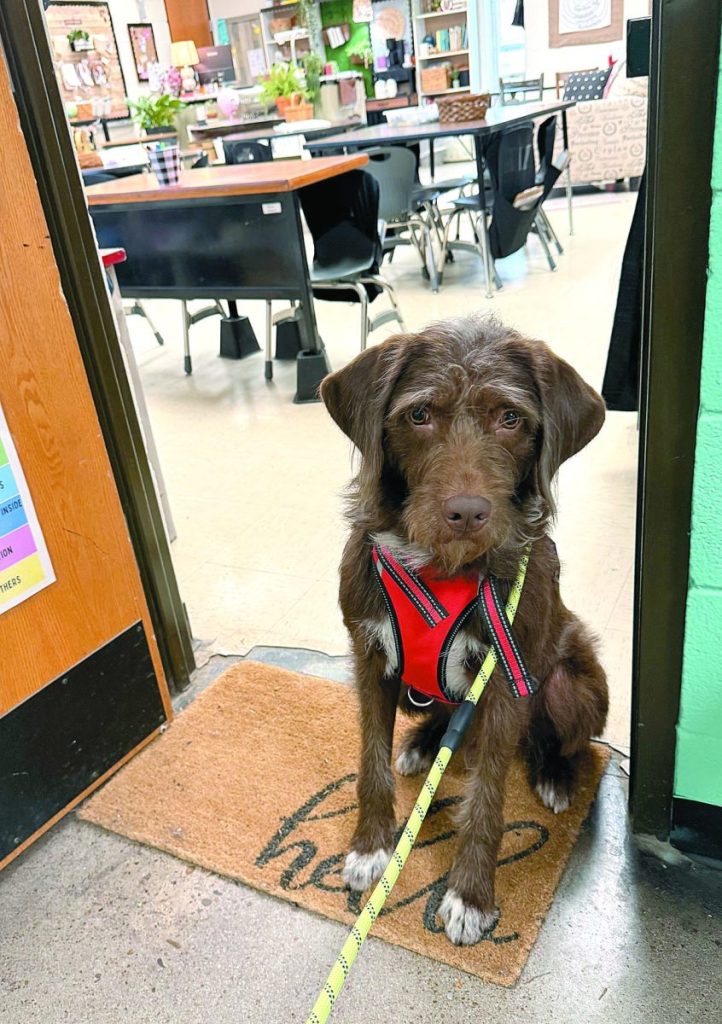
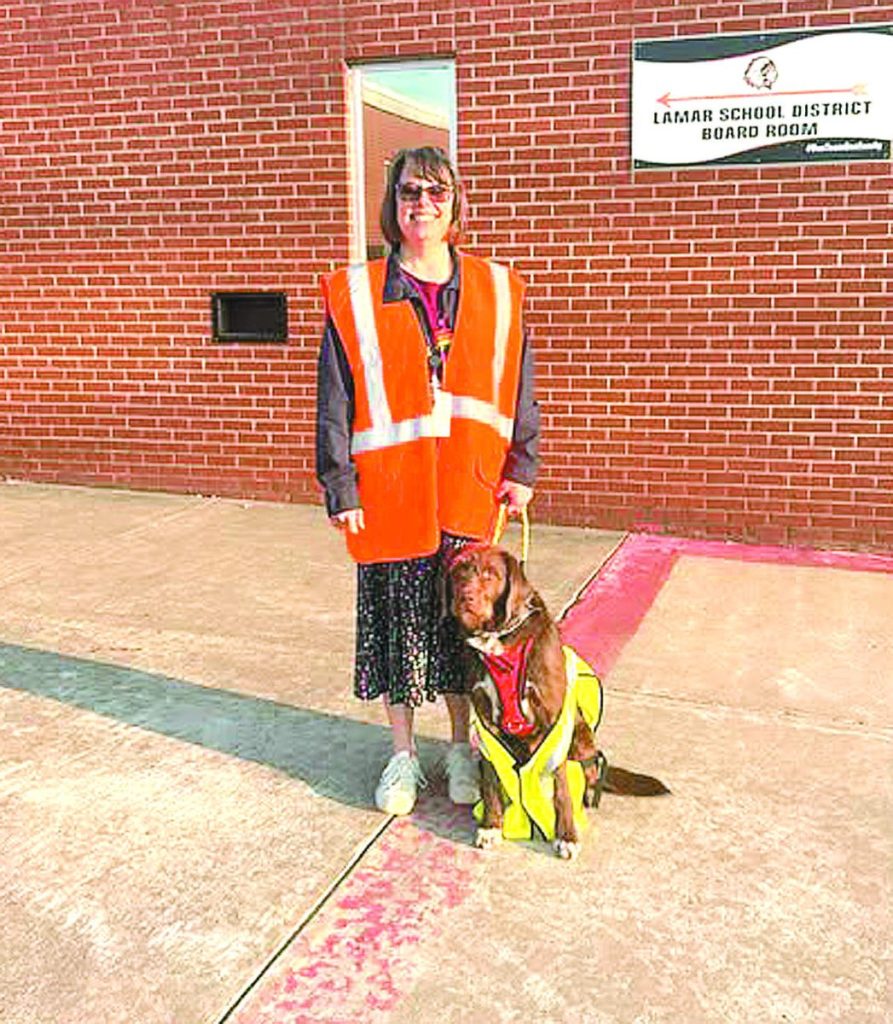
Photo: Diana Bratton with Marshall
Read this story and others in the March 18 issue of The Graphic, available online and at businesses throughout Franklin and Johnson counties. Subscribe or donate here to support more hometown journalism.